









Let’s be honest—everyone thinks humans are bad.
But compared to what’s happening across the animal kingdom?
We’re not even in the same league.
The Real Champion: Cattle
Cows dominate. And it’s not close.
They produce massive amounts of methane thanks to their complex digestive system, which constantly breaks down plant material.
Translation:
They’re basically gas factories running 24/7
And with over a billion cattle on the planet…
the total adds up fast.
Sheep & Goats: Small but Dangerous
They might not look like much—but sheep and goats punch way above their weight.
- Huge global populations
- Same digestive system as cows
- Constant fermentation happening inside
Individually smaller… collectively a problem
Water Buffalo & Camels
Less talked about—but still major contributors.
- Water buffalo are a big source in Asia
- Camels are built for harsh environments—but still produce steady gas
Not as dominant as cows, but far from harmless
Horses: The Quiet Contributors
Horses don’t get much attention here.
But across the world?
They still contribute a measurable amount—just more gradually.
And Then There’s… Humans
Let’s put this in perspective.
Compared to all those animals combined?
Humans barely register.
Yes, we do our part…
but it’s nothing compared to livestock at scale.
See the Full Breakdown
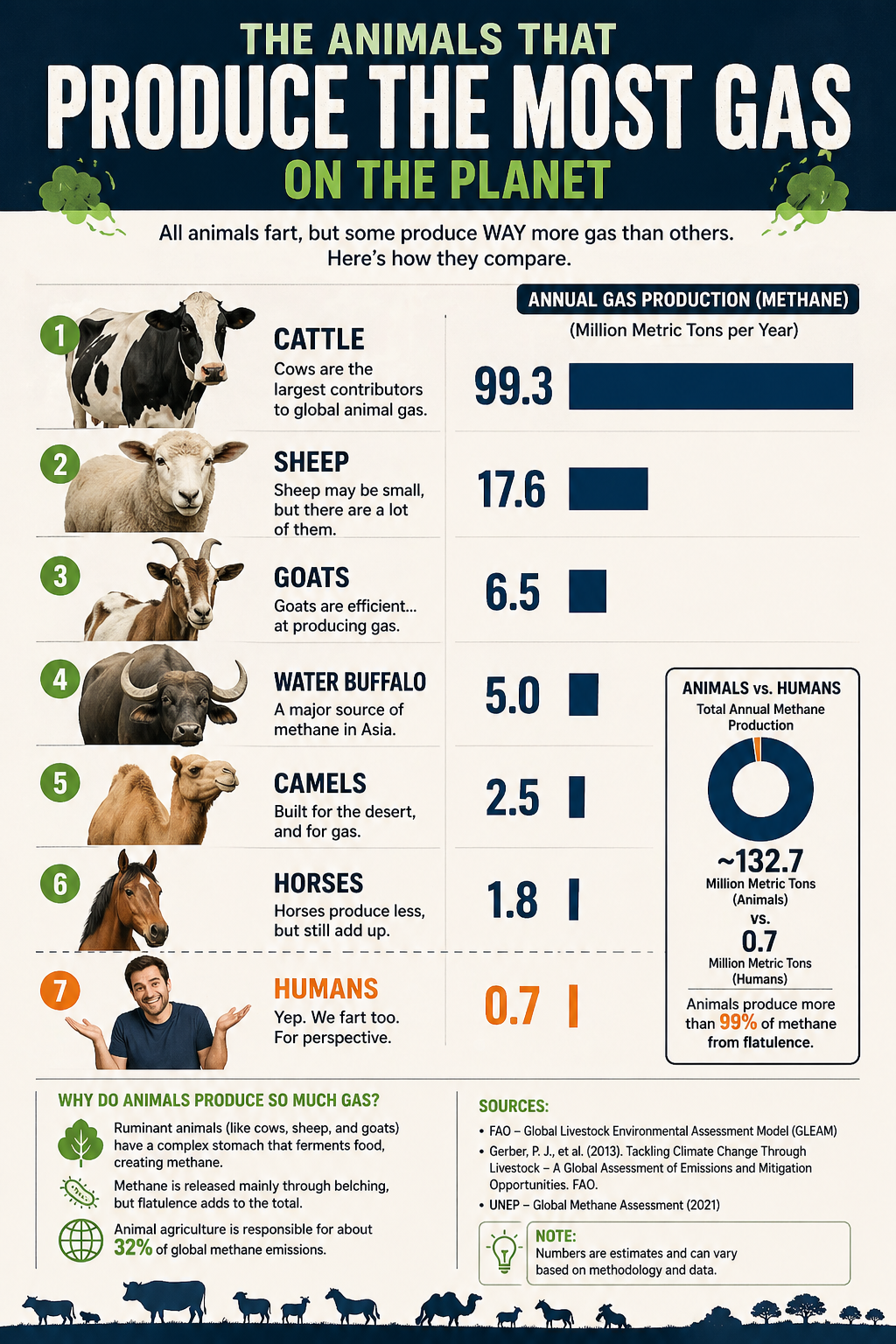
The numbers tell the story better than anything:
- Cattle massively outpace everything
- Smaller animals still add up
- Humans are a tiny fraction
Why This Happens
The key difference comes down to digestion.
Animals like cows, sheep, and goats are ruminants, meaning:
- Their stomachs break down food through fermentation
- That process produces methane
- And it happens constantly
It’s not occasional—it’s built into how they function
The Takeaway
If you ever thought humans were the worst offenders…
Now you know.
We’re not even close.